title: "JEV functions" sidebar_position: 7
JEV functions
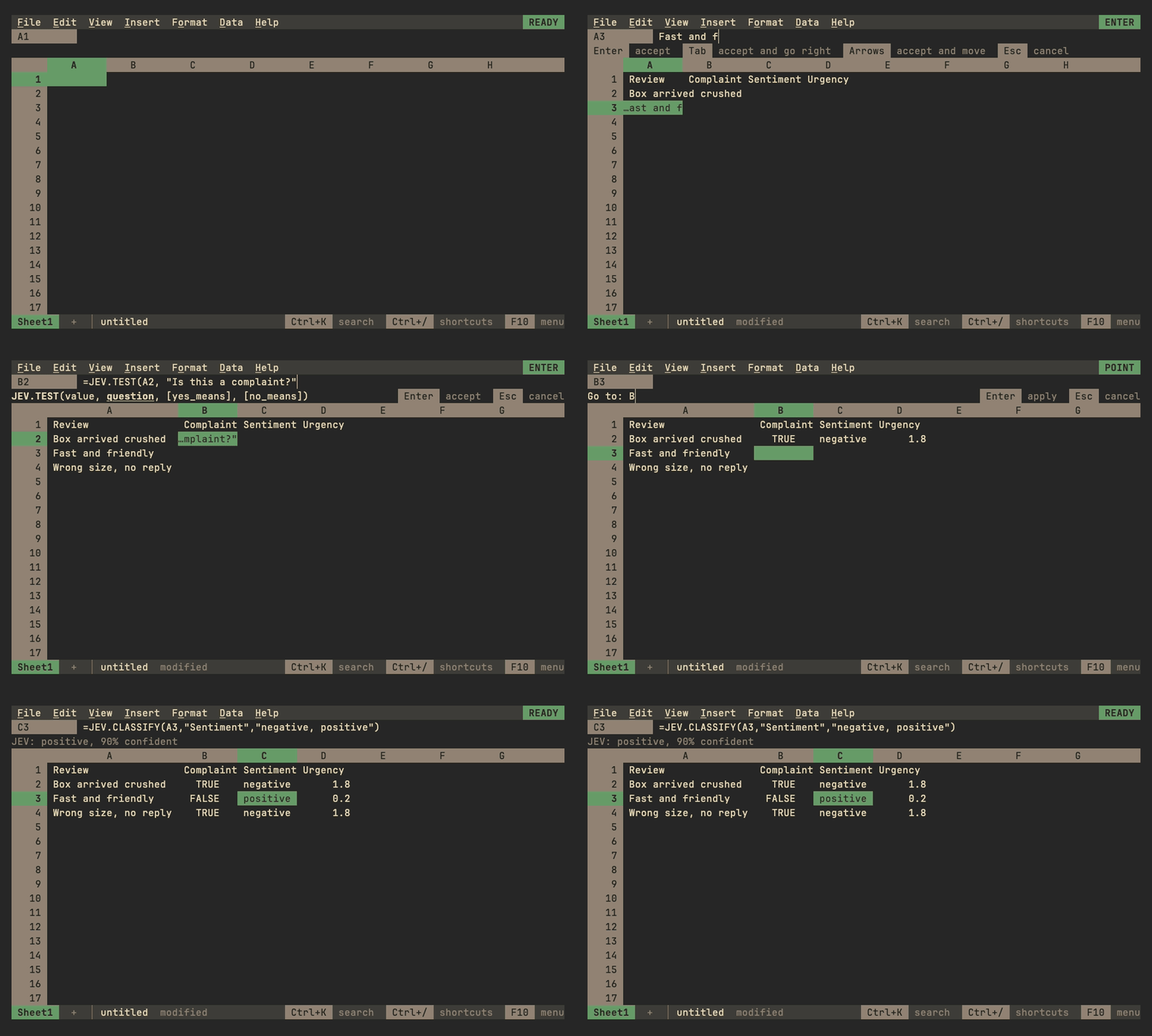
With a TypeSafe API key, four functions ask the hosted JEV model about a value (a cell, a range or text). They follow Sheets' argument style: the value, the question, then what the answers mean.
| Function | Returns | Like |
|---|---|---|
=JEV.TEST(A2, "Is this a complaint?", [yes means], [no means]) |
TRUE or FALSE | an IF condition, a boolean mask |
=JEV.PROB(A2, "Is this a complaint?") |
probability of yes, as a percent | predict_proba |
=JEV.CLASSIFY(A2, "Sentiment", "negative, positive", [descriptions]) |
the best label | SWITCH, pd.cut |
=JEV.SCORE(A2, "Urgency", "low, mid, high") |
a score from 0 to levels-1 | a rating scale |
Labels, descriptions and levels can also be ranges. Answers arrive in the
background (cells show Loading…), are cached by question, and the context
line shows the confidence for the selected cell. Data > Ask JEV again
re-asks the selection.
Without a key the functions show #N/ and say how to add one.
Setup
The API key never goes in a file 012 reads or on a command line. Store it once in your operating system's credential store:
012 config set-key        # asks for the key without echoing it
op read op://Private/TypeSafe/credential | 012 config set-key   # or pipe it in
012 config delete-key     # remove it
or in the app, File > Settings > JEV API key, which asks on the context
line with the key masked and turns JEV on at once. It then checks the key
with one test call, a fixed yes/no question about 2 + 2 = 4 that sends
none of your data, and says "Key saved and checked" or "Key saved, but the
check failed" with the reason (such as the service refusing the key). A
key whose check failed is kept, since a check can fail because the
service can't be reached, not the key; store the right one the same way. 012 config says where the
key would come from, without showing it.
012 looks for the key in this order:
-
TYPESAFE_API_KEYin the environment, for CI, containers and one-off runs. -
The credential store: the macOS Keychain, the Windows Credential Manager, or the Secret Service on Linux and the BSDs (GNOME Keyring, KWallet, KeePassXC; this needs
secret-tool, in thelibsecret-toolspackage on Debian and Ubuntu). The item is service012, accountjev-api-key.jev-credential-store = falsein the config skips it. -
jev-api-key-commandin the config: a command that prints the key, for password managers:jev-api-key-command = op read op://Private/TypeSafe/credential jev-api-key-command = pass show typesafe jev-api-key-command = sh -c 'gpg -dq ~/.secrets/typesafe.gpg | head -1'It runs the first time a sheet asks JEV something, not at every start, for at most 10 seconds, and the first line it prints is the key. It runs without a shell: the value is split into words, with quotes grouping words and a backslash escaping the next character, and nothing is expanded (
$HOME,~,*, pipes and;are passed on literally). For a pipeline, writesh -c '...'yourself.
The service's address and model come from the config file or the
environment only: jev-base-url (or TYPESAFE_BASE_URL), which must be
https unless it's this machine, and jev-model (or
TYPESAFE_DEFAULT_MODEL). See Configuration.
012 doesn't read .env files. A .env next to a downloaded sheet
could set TYPESAFE_BASE_URL and send your key to someone else's server.
If the directory 012 starts in has a .env with TYPESAFE_API_KEY, the
context line suggests 012 config set-key; 012 never reads the key from
it.
How requests behave
A JEV cell's question goes to the answer cache first, and to the service only when it's new:
- The status line counts requests in flight, and terminals that support it (OSC 9;4) show progress in the tab.
- Answers are cached by the exact question, so recalculating, undo and
redo never ask twice, and
JEV.TESTandJEV.PROBon the same question share one request. - Errors in the inputs (
#DIV/in the value, an empty question, fewer than two labels, more than the service's 255 labels or 10 score levels) show as errors at once and are never sent.0! - A failed request shows
#ERROR!, and the context line says why. - 012 never logs, shows or saves the API key anywhere but the credential store, and never passes it as a command-line argument: the macOS Keychain and the Secret Service get it on stdin.
The client is typesafe-go.